
Got a product idea? This is the most important question to ask
4 minutes read
If you have an idea for a new product, or for improving an existing one, what is the most important question to ask? What will be the ROI? Will it be desirable? How long will it take to build? All great questions, but there is a much more important question that you should first ask. A fundamental question that helps to explore the merits of the idea, and whether it’s worth pursuing or not. That question is:
What would have to be true for this idea to be a success?
What would have to be true?
This is the most important question to ask because firstly it can help to determine whether an idea is worth exploring and secondly it can help to focus that exploration. By asking this one question you can start to capture and explore all the different things that can make or break an idea. For example:
- What would have to be true for customers?
- What would have to be true for competitors?
- What would have to be true for our capabilities?
- What would have to be true for our partners?
- What would have to be true for the technology being utilised?
- What other factors would have to be true?
To help to explore these critical questions I’ve created a canvas for capturing key assumptions that would have to be true for an idea to be a success (you can download a PDF version of the canvas at the end of this article). Let’s look at an example.

What would have to be true for Spotify to succeed?
Imagine that you’re Daniel Ek, CEO and co-founder of Spotify, the market leading music streaming service. It’s 2006 and you’ve had the idea of launching a subscription-based music streaming service. Of course, we now know that this idea would turn out to be hugely successful (at least for Spotify, perhaps less so for music artists), but at the time it wasn’t so clear cut. How can Daniel find out if his idea is worth pursuing or not?
One way to explore the merits of a product idea is to spend a lot of time and effort building a working version of the product, and then test it in the marketplace. This will certainly tell you whether the idea is a good one or not but obviously can be a very high-risk approach. If it turns out that the product isn’t such a great idea after all a lot of time and effort will have been wasted. A better approach would be to first ask our critical question: What would have to be true for a music streaming service like Spotify to be a success?
For Spotify, some key assumptions that would have to be true for it to be a success might be:
- Customers are willing to pay for a music streaming service (vs alternatives such as listening to the radio, or buying albums and singles).
- Good enough quality audio can be delivered with relatively low bandwidth (remember, this is 2006).
- Spotify are able to sign up enough music artists to provide adequate selection for customers.
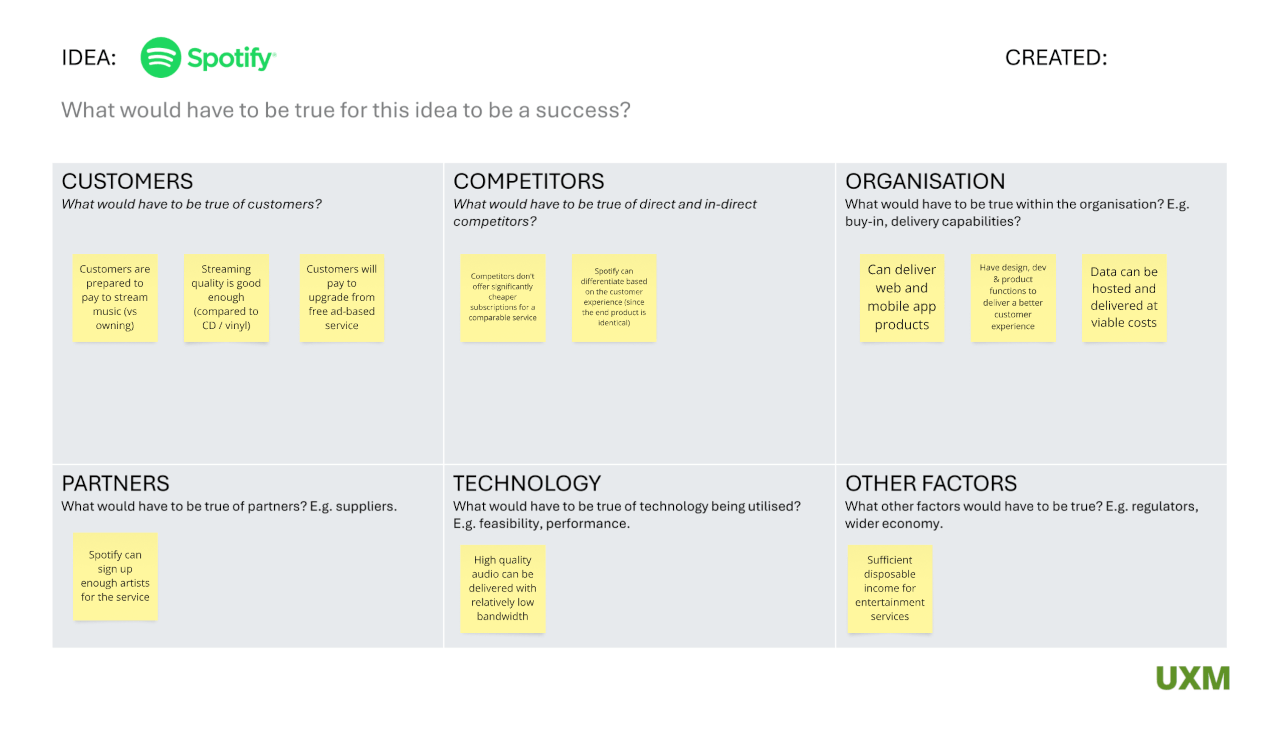
As is the case with Spotify, there are always lots of different things that might have to be true for an idea to be a success. Some will be more critical than others, so how can you identify what is most important? By asking yet another very important question:
What are the riskiest assumptions?
What are the riskiest assumptions?
The riskiest assumptions are the assumptions that are likely to make or break an idea. To identify the riskiest assumptions you can consider the following for each assumption:
- What is the risk of the assumption being incorrect? Does the success of the idea hinge on this assumption, or if turns out to be incorrect would there be relatively little impact?
- How confident are you in the assumption? Is there a lot of evidence supporting the assumption, or is it more like wishful thinking?
A great way to identify the riskiest assumptions is by mapping assumptions by risk and confidence (you can download a PDF version of the below grid at the end of this article).
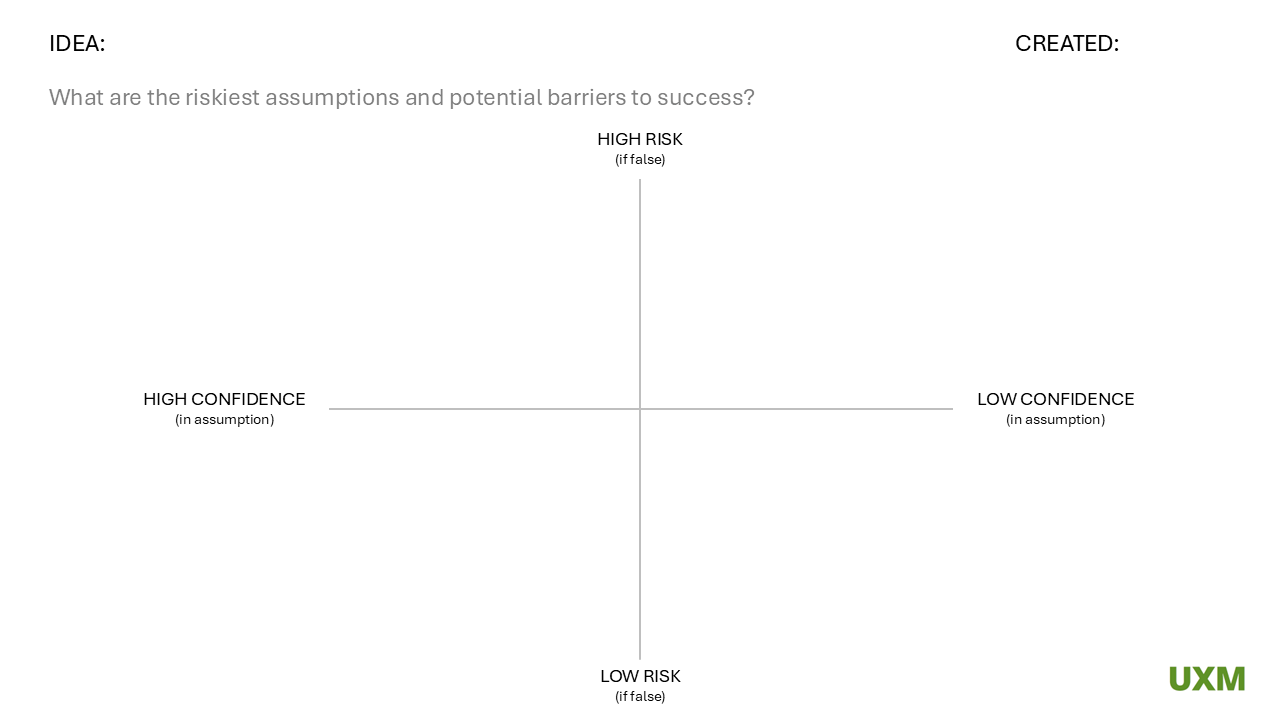
By exploring the risk and confidence of assumptions, you can quickly identify the riskiest assumptions. These will typically be high-risk assumptions where there is low confidence. In other words, assumptions that can make or break an idea, but where you’re lacking evidence to support the assumption.
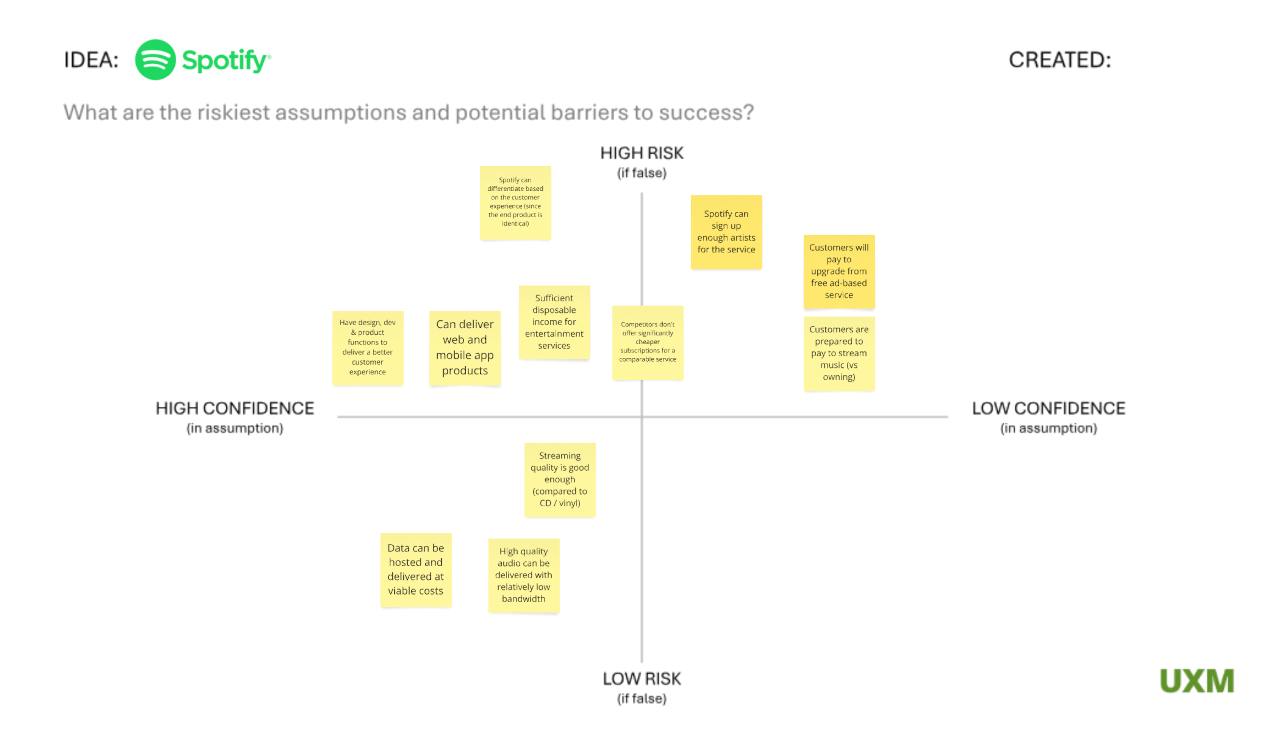
Coming back to our Spotify example, some of the riskiest assumptions might be:
- Spotify can sign up enough artists for the service.
- Customers will pay over free alternatives, such as the radio and YouTube.
- Customers are prepared to pay to stream music, but not own it.
Test the riskiest assumptions
Having identified the riskiest assumptions, you should consider how to test them without actually building and launching the product idea. By utilising user research methods such as user surveys, user interviews, diary studies, user testing, prototyping, and concept testing you can gather qualitative and quantitative evidence to help test your riskiest assumptions.
Some ways to test the key assumption that customers are prepared to pay to stream music could be:
- Carry out concept testing with storyboards and/or a prototype to explore how the Spotify subscription model would work for customers, including pricing.
- Run a user survey capturing use of, and attitudes towards streaming music.
- Run user interviews exploring attitudes towards streaming music.
By starting with the question, “What would have to be true?” and then identifying and testing your riskiest assumptions, you can move from guesswork to informed decision-making. This approach not only helps to reduce wasted time and effort, it should increase your chances of building something truly successful.
Resources
See also
Image credits
Question mark photo by Simone Secci on Unsplash


